Analytic results
Circumference
The ratio of a circle's circumference to its diameter is π (pi), an irrational constant approximately equal to 3.141592654. Thus the circumference C is related to the radius r and diameter d by:

Area enclosed

As proved by Archimedes, in his Measurement of a Circle, the area enclosed by a circle is equal to that of a triangle whose base has the length of the circle's circumference and whose height equals the circle's radius,[11] which comes to π multiplied by the radius squared:

Equivalently, denoting diameter by d,
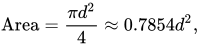
The circle is the plane curve enclosing the maximum area for a given arc length. This relates the circle to a problem in the calculus of variations, namely the isoperimetric inequality.
Equations
Cartesian coordinates

Equation of a circle
In an x–y Cartesian coordinate system, the circle with centre coordinates (a, b) and radius r is the set of all points (x, y) such that

This equation, known as the equation of the circle, follows from the Pythagorean theorem applied to any point on the circle: as shown in the adjacent diagram, the radius is the hypotenuse of a right-angled triangle whose other sides are of length |x − a| and |y − b|. If the circle is centred at the origin (0, 0), then the equation simplifies to

Parametric form
The equation can be written in parametric form using the trigonometric functions sine and cosine as
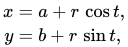
An alternative parametrisation of the circle is
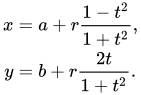
In this parameterisation, the ratio of t to r can be interpreted geometrically as the stereographic projection of the line passing through the centre parallel to the x axis (see Tangent half-angle substitution). However, this parameterisation works only if t is made to range not only through all reals but also to a point at infinity; otherwise, the leftmost point of the circle would be omitted.
3-point form
The equation of the circle determined by three points not on a line is obtained by a conversion of the 3-point form of a circle equation:


Homogeneous form
In homogeneous coordinates, each conic section with the equation of a circle has the form

It can be proven that a conic section is a circle exactly when it contains (when extended to the complex projective plane) the points I(1: i: 0) and J(1: −i: 0). These points are called the circular points at infinity.
Polar coordinates
In polar coordinates, the equation of a circle is

where a is the radius of the circle, are the polar coordinates of a generic point on the circle, and are the polar coordinates of the centre of the circle (i.e., r0 is the distance from the origin to the centre of the circle, and φ is the anticlockwise angle from the positive x axis to the line connecting the origin to the centre of the circle). For a circle centred on the origin, i.e. r0 = 0, this reduces to r = a. When r0 = a, or when the origin lies on the circle, the equation becomes



In the general case, the equation can be solved for r, giving

Complex plane
In the complex plane, a circle with a centre at c and radius r has the equation

In parametric form, this can be written as

The slightly generalised equation

for real p, q and complex g is sometimes called a generalised circle. This becomes the above equation for a circle with , since . Not all generalised circles are actually circles: a generalised circle is either a (true) circle or a line.


Tangent lines
The tangent line through a point P on the circle is perpendicular to the diameter passing through P. If P = (x1, y1) and the circle has centre (a, b) and radius r, then the tangent line is perpendicular to the line from (a, b) to (x1, y1), so it has the form (x1 − a)x + (y1 – b)y = c. Evaluating at (x1, y1) determines the value of c, and the result is that the equation of the tangent is


If y1 ≠ b, then the slope of this line is
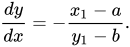
This can also be found using implicit differentiation.
When the centre of the circle is at the origin, then the equation of the tangent line becomes


Properties
- The circle is the shape with the largest area for a given length of perimeter (see Isoperimetric inequality).
- The circle is a highly symmetric shape: every line through the centre forms a line of reflection symmetry, and it has rotational symmetry around the centre for every angle. Its symmetry group is the orthogonal group O(2,R). The group of rotations alone is the circle group T.
- All circles are similar.[12]
- A circle circumference and radius are proportional.
- The area enclosed and the square of its radius are proportional.
- The constants of proportionality are 2π and π respectively.
- The circle that is centred at the origin with radius 1 is called the unit circle.
- Thought of as a great circle of the unit sphere, it becomes the Riemannian circle.
- Through any three points, not all on the same line, there lies a unique circle. In Cartesian coordinates, it is possible to give explicit formulae for the coordinates of the centre of the circle and the radius in terms of the coordinates of the three given points. See circumcircle.
Chord
- Chords are equidistant from the centre of a circle if and only if they are equal in length.
- The perpendicular bisector of a chord passes through the centre of a circle; equivalent statements stemming from the uniqueness of the perpendicular bisector are:
- A perpendicular line from the centre of a circle bisects the chord.
- The line segment through the centre bisecting a chord is perpendicular to the chord.
- If a central angle and an inscribed angle of a circle are subtended by the same chord and on the same side of the chord, then the central angle is twice the inscribed angle.
- If two angles are inscribed on the same chord and on the same side of the chord, then they are equal.
- If two angles are inscribed on the same chord and on opposite sides of the chord, then they are supplementary.
- For a cyclic quadrilateral, the exterior angle is equal to the interior opposite angle.
- An inscribed angle subtended by a diameter is a right angle (see Thales' theorem).
- The diameter is the longest chord of the circle.
- Among all the circles with a chord AB in common, the circle with minimal radius is the one with diameter AB.
- If the intersection of any two chords divides one chord into lengths a and b and divides the other chord into lengths c and d, then ab = cd.
- If the intersection of any two perpendicular chords divides one chord into lengths a and b and divides the other chord into lengths c and d, then a2 + b2 + c2 + d2 equals the square of the diameter.[13]
- The sum of the squared lengths of any two chords intersecting at right angles at a given point is the same as that of any other two perpendicular chords intersecting at the same point and is given by 8r2 − 4p2, where r is the circle radius, and p is the distance from the centre point to the point of intersection.[14]
- The distance from a point on the circle to a given chord times the diameter of the circle equals the product of the distances from the point to the ends of the chord.[15]: p.71
Tangent
- A line drawn perpendicular to a radius through the end point of the radius lying on the circle is a tangent to the circle.
- A line drawn perpendicular to a tangent through the point of contact with a circle passes through the centre of the circle.
- Two tangents can always be drawn to a circle from any point outside the circle, and these tangents are equal in length.
- If a tangent at A and a tangent at B intersect at the exterior point P, then denoting the centre as O, the angles ∠BOA and ∠BPA are supplementary.
- If AD is tangent to the circle at A and if AQ is a chord of the circle, then ∠DAQ = 12arc(AQ).
Theorems

- The chord theorem states that if two chords, CD and EB, intersect at A, then AC × AD = AB × AE.
- If two secants, AE and AD, also cut the circle at B and C respectively, then AC × AD = AB × AE (corollary of the chord theorem).
- A tangent can be considered a limiting case of a secant whose ends are coincident. If a tangent from an external point A meets the circle at F and a secant from the external point A meets the circle at C and D respectively, then AF2 = AC × AD (tangent–secant theorem).
- The angle between a chord and the tangent at one of its endpoints is equal to one half the angle subtended at the centre of the circle, on the opposite side of the chord (tangent chord angle).
- If the angle subtended by the chord at the centre is 90°, then ℓ = r √2, where ℓ is the length of the chord, and r is the radius of the circle.
- If two secants are inscribed in the circle as shown at right, then the measurement of angle A is equal to one half the difference of the measurements of the enclosed arcs ( and ). That is, , where O is the centre of the circle (secant–secant theorem).



Inscribed angles

An inscribed angle (examples are the blue and green angles in the figure) is exactly half the corresponding central angle (red). Hence, all inscribed angles that subtend the same arc (pink) are equal. Angles inscribed on the arc (brown) are supplementary. In particular, every inscribed angle that subtends a diameter is a right angle (since the central angle is 180°).
Sagitta

The sagitta (also known as the versine) is a line segment drawn perpendicular to a chord, between the midpoint of that chord and the arc of the circle.
Given the length y of a chord and the length x of the sagitta, the Pythagorean theorem can be used to calculate the radius of the unique circle that will fit around the two lines:
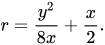
Another proof of this result, which relies only on two chord properties given above, is as follows. Given a chord of length y and with sagitta of length x, since the sagitta intersects the midpoint of the chord, we know that it is a part of a diameter of the circle. Since the diameter is twice the radius, the "missing" part of the diameter is (2r − x) in length. Using the fact that one part of one chord times the other part is equal to the same product taken along a chord intersecting the first chord, we find that (2r − x)x = (y / 2)2. Solving for r, we find the required result.
Compass and straightedge constructions
There are many compass-and-straightedge constructions resulting in circles.
The simplest and most basic is the construction given the centre of the circle and a point on the circle. Place the fixed leg of the compass on the centre point, the movable leg on the point on the circle and rotate the compass.
Construction with given diameter
- Construct the midpoint M of the diameter.
- Construct the circle with centre M passing through one of the endpoints of the diameter (it will also pass through the other endpoint).

Construction through three noncollinear points
- Name the points P, Q and R,
- Construct the perpendicular bisector of the segment PQ.
- Construct the perpendicular bisector of the segment PR.
- Label the point of intersection of these two perpendicular bisectors M. (They meet because the points are not collinear).
- Construct the circle with centre M passing through one of the points P, Q or R (it will also pass through the other two points).
Circle of Apollonius

Apollonius of Perga showed that a circle may also be defined as the set of points in a plane having a constant ratio (other than 1) of distances to two fixed foci, A and B.[16][17] (The set of points where the distances are equal is the perpendicular bisector of segment AB, a line.) That circle is sometimes said to be drawn about two points.
The proof is in two parts. First, one must prove that, given two foci A and B and a ratio of distances, any point P satisfying the ratio of distances must fall on a particular circle. Let C be another point, also satisfying the ratio and lying on segment AB. By the angle bisector theorem the line segment PC will bisect the interior angle APB, since the segments are similar:
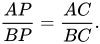
Analogously, a line segment PD through some point D on AB extended bisects the corresponding exterior angle BPQ where Q is on AP extended. Since the interior and exterior angles sum to 180 degrees, the angle CPD is exactly 90 degrees; that is, a right angle. The set of points P such that angle CPD is a right angle forms a circle, of which CD is a diameter.
Second, see[18]: 15 for a proof that every point on the indicated circle satisfies the given ratio.
Cross-ratios
A closely related property of circles involves the geometry of the cross-ratio of points in the complex plane. If A, B, and C are as above, then the circle of Apollonius for these three points is the collection of points P for which the absolute value of the cross-ratio is equal to one:
![{\displaystyle {\bigl |}[A,B;C,P]{\bigr |}=1.}](https://wikimedia.org/api/rest_v1/media/math/render/svg/d29d2d228c14547650d9f23bc20322d363157303)
Stated another way, P is a point on the circle of Apollonius if and only if the cross-ratio [A, B; C, P] is on the unit circle in the complex plane.
Generalised circles
If C is the midpoint of the segment AB, then the collection of points P satisfying the Apollonius condition
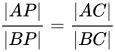
Thus, if A, B, and C are given distinct points in the plane, then the locus of points P satisfying the above equation is called a "generalised circle." It may either be a true circle or a line. In this sense a line is a generalised circle of infinite radius.
Inscription in or circumscription about other figures
In every triangle a unique circle, called the incircle, can be inscribed such that it is tangent to each of the three sides of the triangle.[19]
About every triangle a unique circle, called the circumcircle, can be circumscribed such that it goes through each of the triangle's three vertices.[20]
A tangential polygon, such as a tangential quadrilateral, is any convex polygon within which a circle can be inscribed that is tangent to each side of the polygon.[21] Every regular polygon and every triangle is a tangential polygon.
A cyclic polygon is any convex polygon about which a circle can be circumscribed, passing through each vertex. A well-studied example is the cyclic quadrilateral. Every regular polygon and every triangle is a cyclic polygon. A polygon that is both cyclic and tangential is called a bicentric polygon.
A hypocycloid is a curve that is inscribed in a given circle by tracing a fixed point on a smaller circle that rolls within and tangent to the given circle.
Limiting case of other figures
The circle can be viewed as a limiting case of various other figures:
- The series of regular polygons with n sides has the circle as its limit as n approaches infinity. This fact was applied by Archimedes to approximate π.
- A Cartesian oval is a set of points such that a weighted sum of the distances from any of its points to two fixed points (foci) is a constant. An ellipse is the case in which the weights are equal. A circle is an ellipse with an eccentricity of zero, meaning that the two foci coincide with each other as the centre of the circle. A circle is also a different special case of a Cartesian oval in which one of the weights is zero.
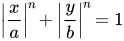
- A superellipse has an equation of the form for positive a, b, and n. A supercircle has b =a. A circle is the special case of a supercircle in which n = 2.
- A Cassini oval is a set of points such that the product of the distances from any of its points to two fixed points is a constant. When the two fixed points coincide, a circle results.
- A curve of constant width is a figure whose width, defined as the perpendicular distance between two distinct parallel lines each intersecting its boundary in a single point, is the same regardless of the direction of those two parallel lines. The circle is the simplest example of this type of figure.
Locus of constant sum
Consider a finite set of points in the plane. The locus of points such that the sum of the squares of the distances to the given points is constant is a circle, whose centre is at the centroid of the given points.[22] A generalization for higher powers of distances is obtained if under points the vertices of the regular polygon are taken.[23] The locus of points such that the sum of the -th power of distances to the vertices of a given regular polygon with circumradius is constant is a circle, if



In the case of the equilateral triangle, the loci of the constant sums of the second and fourth powers are circles, whereas for the square, the loci are circles for the constant sums of the second, fourth, and sixth powers. For the regular pentagon the constant sum of the eighth powers of the distances will be added and so forth.
Squaring the circle
Squaring the circle is the problem, proposed by ancient geometers, of constructing a square with the same area as a given circle by using only a finite number of steps with compass and straightedge.
In 1882, the task was proven to be impossible, as a consequence of the Lindemann–Weierstrass theorem, which proves that pi (π) is a transcendental number, rather than an algebraic irrational number; that is, it is not the root of any polynomial with rational coefficients. Despite the impossibility, this topic continues to be of interest for pseudomath enthusiasts.
Generalizations
In other p-norms

Defining a circle as the set of points with a fixed distance from a point, different shapes can be considered circles under different definitions of distance. In p-norm, distance is determined by


In taxicab geometry, p = 1. Taxicab circles are squares with sides oriented at a 45° angle to the coordinate axes. While each side would have length using a Euclidean metric, where r is the circle's radius, its length in taxicab geometry is 2r. Thus, a circle's circumference is 8r. Thus, the value of a geometric analog to is 4 in this geometry. The formula for the unit circle in taxicab geometry is in Cartesian coordinates and


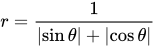
A circle of radius 1 (using this distance) is the von Neumann neighborhood of its centre.
A circle of radius r for the Chebyshev distance (L∞ metric) on a plane is also a square with side length 2r parallel to the coordinate axes, so planar Chebyshev distance can be viewed as equivalent by rotation and scaling to planar taxicab distance. However, this equivalence between L1 and L∞ metrics does not generalize to higher dimensions.
Topological definition
The circle is the one-dimensional hypersphere (the 1-sphere).
In topology, a circle is not limited to the geometric concept, but to all of its homeomorphisms. Two topological circles are equivalent if one can be transformed into the other via a deformation of R3 upon itself (known as an ambient isotopy).[24]
Comments
Post a Comment